When someone says, “I want a better smile,” the answer should never immediately be, “You need braces,” or, “You need veneers.”
That is not diagnosis. That is guessing with confidence.
The real starting point is a proper conversation. Before we even consider dental treatment, especially anything irreversible, we need to understand what the patient truly wants. Not just what they think they need. Not just what they have seen on Instagram. Not just the quickest route to a dramatic before and after.
We need to ask what is actually bothering them. Is it the position of the teeth? Is it the shape of the teeth? Is it the colour? Is it the gum line? Is it the way the teeth sit in the face? Is it the bite? Or is it a combination of all of these?
This is why the orthodontics versus veneers debate is never a simple argument between two treatments. It is a discussion about diagnosis, biology, aesthetics, consent, maintenance and long term stability.
The first question: are we changing tooth position or tooth shape?
The first question we have to answer is whether the position of the teeth is the main problem.
Are the teeth crowded? Are they rotated? Are they tipped? Are they flared forwards? Are they leaning inwards? Is the arch narrow? Are the teeth sitting too far out of the mouth? Is the upper arch in the correct relationship with the lower arch?
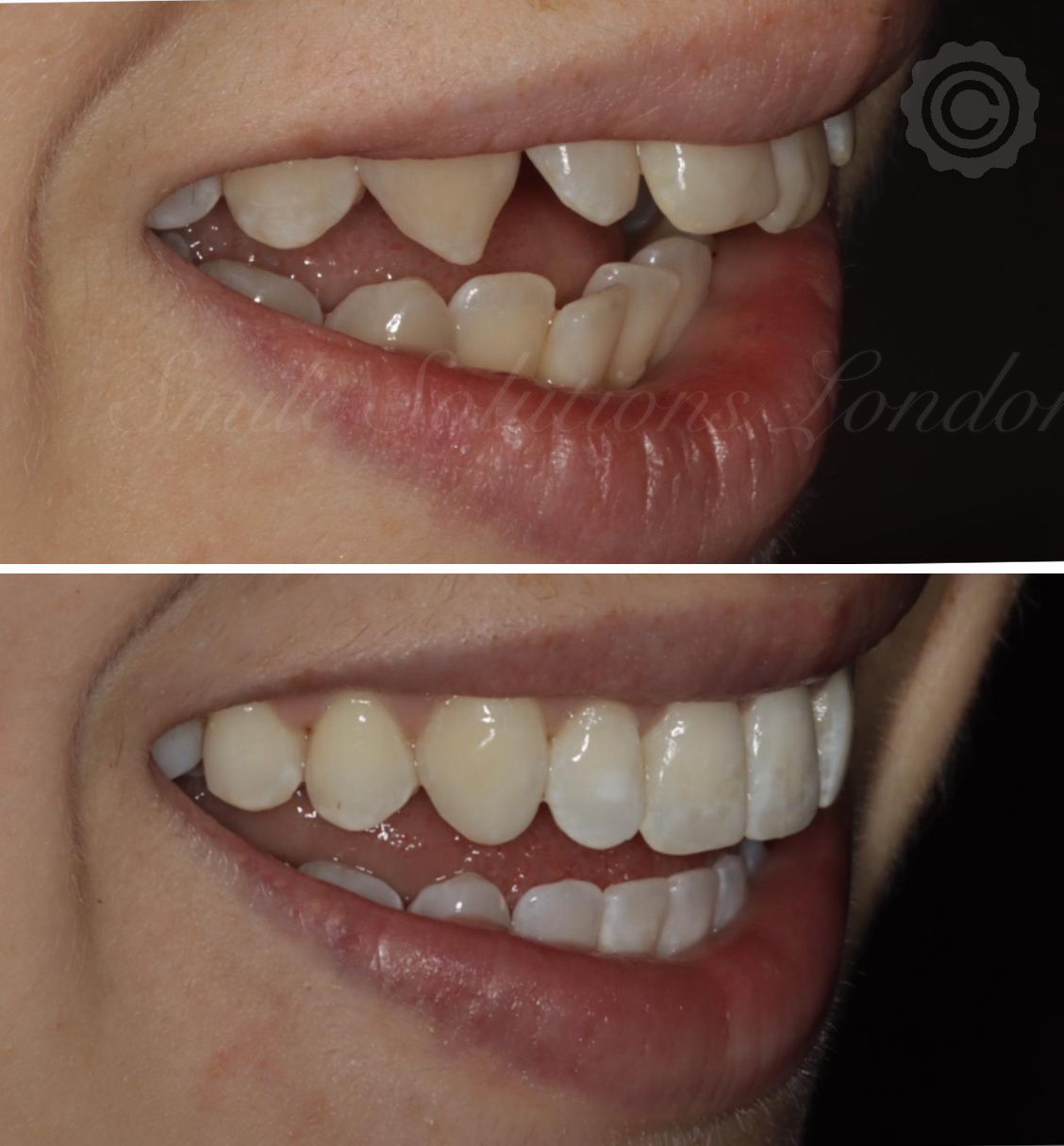
If the issue is mainly tooth position, then orthodontics may be the most sensible and conservative way to create the foundation for a better smile. Moving the teeth into a more ideal arch form can sometimes completely change the appearance of the smile without having to cover the teeth at all.
But the next question is just as important. If we moved the teeth into a better position, would that alone satisfy the patient’s aesthetic wishes?
For some patients, the answer is yes. Once the teeth are aligned, levelled, expanded slightly, uprighted, or brought into better proportion within the smile, the result may be enough. With whitening, small amounts of edge reshaping, and perhaps a little composite bonding in carefully selected areas, we may be able to achieve a beautiful result with minimal damage to the natural teeth.
That is elegant dentistry when it is possible.
For other patients, orthodontics alone will not be enough, because the shape of the teeth also needs attention.
The teeth may be naturally small. The lateral incisors may be peg shaped. The edges may be worn. There may be fractures, old fillings, staining, enamel defects, asymmetry, or proportions that simply do not work aesthetically. In those situations, orthodontics may improve the foundation, but restorative dentistry may still be needed to create the final tooth shape.
Why tooth position matters before veneers
If a change in tooth shape is required, we then have to ask a very important planning question.
Can we move the teeth first so that the final restorative treatment can be more conservative?
Could orthodontics create the right space for non prep veneers? Could it allow us to use additive composite bonding rather than removing healthy enamel? Could it reduce the amount of ceramic thickness needed? Could it stop us from pushing veneers too far forward just to disguise crowded or poorly positioned teeth?
This is where good planning protects teeth.
When teeth are poorly positioned and veneers are used to correct both shape and position, the ceramic is being asked to do too much. It has to create the illusion of straight teeth, while also changing the shape, size, colour and proportions.
That usually comes at a biological cost.
The more the veneer has to compensate for tooth position, the more tooth reduction may be required. And once healthy enamel is removed, it cannot be put back.
This does not mean veneers are wrong. Veneers can be beautiful, predictable and life changing when they are planned properly, bonded well and used for the right reasons.
But veneers should not be used as a shortcut without explaining what is being sacrificed.
If a patient does not want orthodontics, that is absolutely their choice. But it must be an informed choice. They need to understand whether avoiding orthodontics means accepting more tooth preparation, thicker ceramics, a more compromised result, or a different long term maintenance burden.
That conversation must happen before a drill touches a tooth.
Looking beyond the teeth
A smile is not just a row of teeth. It sits inside a face.
That means we have to assess the soft tissues, the lips, the smile line, the gum levels, the arch form and the relationship between the upper and lower jaws.
Where do the teeth sit when the patient smiles? How much tooth shows at rest and in full smile? How high is the lip line? Does the patient show too much gum? Are the gum margins level? Are the teeth the wrong size, or do they only appear short because the gum sits too low over them?
Sometimes a patient thinks they need longer teeth, when the real issue is the gum line. Sometimes they think they need veneers, when the real issue is tooth position. Sometimes they think the smile is too narrow, when the true issue is arch form. Sometimes they think they need a full set of ceramics, when the more intelligent treatment may be orthodontics, whitening and small additions of composite.
We also need to ask whether the arch form can be improved. Can the upper arch be widened orthodontically? Can the teeth be uprighted? Can the relationship between the upper and lower teeth be improved? Is there a jaw relationship issue that needs to be understood before aesthetic treatment is planned?
These are not small details. They are the difference between dentistry that looks good on the day and dentistry that still makes sense years later.
The gum line, proportions and smile design
Tooth size and gum position are closely connected.
If the teeth look short, is it because the teeth are actually short, or because too much gum is covering them? If the gum line is uneven, is that making one tooth look longer or shorter than the other? Is there a need for gum contouring, periodontal treatment, or crown lengthening before any veneer work is considered?
We also need to look at proportions. Are the teeth balanced with each other? Are the central incisors dominant enough? Are the lateral incisors too small? Are the canines in the correct visual position? Does the smile follow the lower lip? Does it suit the patient’s face?
This is where smile design must be individual. Teeth should not be designed from a template. A smile that looks beautiful on one face may look completely wrong on another.
Health before aesthetics
Before deciding between orthodontics, veneers, bonding or crowns, we have to assess the health of the mouth.
What is the periodontal health like? Are the gums stable? Is there inflammation, bleeding or recession? Can the patient clean effectively around the proposed treatment?
What is the condition of the teeth? Are they worn, fractured, stained, heavily restored, root filled, cracked, or structurally weak? Is there enough enamel for predictable bonding? Are there old fillings that need to be considered? Are there missing teeth? Has there been previous orthodontic treatment? Is there a history of relapse?
We also have to assess the bite. Is there grinding or clenching? Is there a deep bite? Is there edge to edge contact? Are the lower teeth damaging the upper teeth? Will ceramic placed in that bite be protected, or will it be put straight into danger?
The roots and supporting bone matter too. Where are the roots sitting within the jawbone? Are the roots healthy and long enough for the proposed orthodontic movement? Is there enough bone support? Are there medical factors or medications that may affect gum health, healing, saliva, staining, or maintenance?
All of this influences the recommendation.
Cosmetic dentistry should never be planned separately from general dental health. A beautiful result that cannot be cleaned, maintained or protected is not beautiful dentistry. It is delayed disappointment.
If orthodontics is chosen
Orthodontics can be a wonderful way to improve a smile because it changes the position of the natural teeth rather than covering them.
But orthodontics comes with a responsibility. The treatment does not finish when the teeth look straight. That is when retention begins.
Teeth have been moved through bone, ligament, gum fibres, lips, tongue and bite forces. Once they have moved, they need to be held. That may involve removable clear retainers worn at night, a fixed retainer bonded behind the teeth, or often a combination of both.
Retention is not an optional extra. It is part of orthodontic treatment.
If a patient is not willing to wear retainers or have them checked, they need to understand that teeth can move again. Relapse is not rare. Teeth continue to respond to ageing, bite forces and soft tissue pressures throughout life.
So when we discuss orthodontics, we must also discuss retention, repair, replacement, hygiene and long term maintenance.
If veneers are chosen
Veneers can give more control over shape, surface texture, proportion and colour. They can be incredibly natural when designed well, especially when they are bonded mainly to enamel and the bite has been properly planned.
But veneers are not magic shields.
The tooth underneath still exists. The gum around the veneer still matters. The bonding interface still matters. The bite still matters. The margin still matters. The natural teeth around the veneers can darken over time. The underlying tooth shade can influence the final appearance. Cement and margins can age. Gum levels can change.
Patients also need to understand whitening. If a patient wants very white teeth long term, will they continue whitening the natural teeth around the veneers? Are they expecting the veneers to stay identical forever? Do they understand that the mouth is a living environment and that maintenance is part of the treatment?
Ceramic veneers can be long lasting, but they are still dental restorations. They must be designed, bonded, protected and maintained.
Sometimes the best plan is a combination
Very often, the cleverest treatment plan is not orthodontics or veneers. It is orthodontics and restorative refinement.
Orthodontics can put the teeth in the best possible position. Whitening can improve the base colour. Composite bonding or ceramic veneers can then be used only where needed to refine the final shape, edges, proportions and symmetry.
This approach often allows us to preserve more tooth structure.
Instead of using ceramic to hide a positional problem, we correct the position first. Then the veneer, if needed, can be thinner, more natural and more respectful to the tooth underneath.
In other cases, orthodontics alone may be enough. A small amount of tooth shaping and clever composite bonding may provide the best balance between aesthetics, biology and maintenance.
And sometimes, orthodontics is not the answer. If teeth are heavily worn, fractured, broken down, heavily filled or already compromised, then ceramic veneers, onlays or crowns may be the more appropriate treatment.
The point is that the treatment must be chosen because it matches the diagnosis, not because it photographs well.
The clinician’s role
This is where the clinician’s knowledge matters.
To advise properly, a dentist must understand orthodontics, occlusion, periodontics, restorative dentistry, adhesive dentistry, facial aesthetics, smile design and dental anatomy. They also need vision. They need to see where the case could go, what is biologically possible, what is risky, and what the patient will realistically be able to maintain.
Good cosmetic dentistry is not just about making teeth whiter or straighter.
It is about knowing when not to cut.
It is about knowing when to move teeth first.
It is about knowing when ceramics are appropriate.
It is about knowing when the gums are the real issue.
It is about knowing when a patient’s expectations need to be slowed down and properly explored.
In UK dentistry, consent is not just a signature on a form. Valid consent is the discussion. The patient must understand the options, risks, benefits, alternatives, likely costs, consequences of no treatment and the maintenance involved.
That is especially important when treatment is irreversible.
The real debate: diagnosis versus shortcut
So, orthodontics versus veneers?
There is no universal winner.
For one patient, orthodontics may be the most conservative and beautiful solution.
For another, veneers may be the right answer because the tooth shape, enamel, wear or old restorations need restorative treatment.
For many patients, the best result comes from combining orthodontics with whitening, gum management, composite bonding or ceramics.
The real debate is not orthodontics versus veneers.
The real debate is diagnosis versus shortcut.
Before choosing any irreversible cosmetic dental treatment, ask what the actual problem is. Ask whether the teeth need to be moved. Ask whether the shape needs to be changed. Ask how much tooth will be removed. Ask whether the bite has been assessed. Ask whether the gums are healthy. Ask how the result will be maintained.
And if you are unsure, get another opinion. Not only a second opinion. Sometimes a third or fourth opinion is wise before healthy tooth structure is removed.
Because once enamel is gone, it is gone.
The best dentistry is not the treatment that looks most dramatic on day one. It is the treatment that still makes biological, aesthetic and emotional sense years later.
Book a proper conversation, not a quick quote
If you are weighing up braces, veneers, or a combination of the two, the honest first step is a full assessment, not a price. At Smile Solutions London in Hampstead, every smile begins with diagnosis: your teeth, your bite, your gums, your face and what you genuinely want to change. From there we talk you through every option, what each one preserves, what it costs biologically as well as financially, and how it is maintained, so that any decision is truly yours and truly informed.
To arrange a consultation with us at 24 Englands Lane, Hampstead, NW3 4TG, book online or call the practice. We would rather spend time understanding your smile than rush you towards anything irreversible.